Craft - AI Presentation Engine
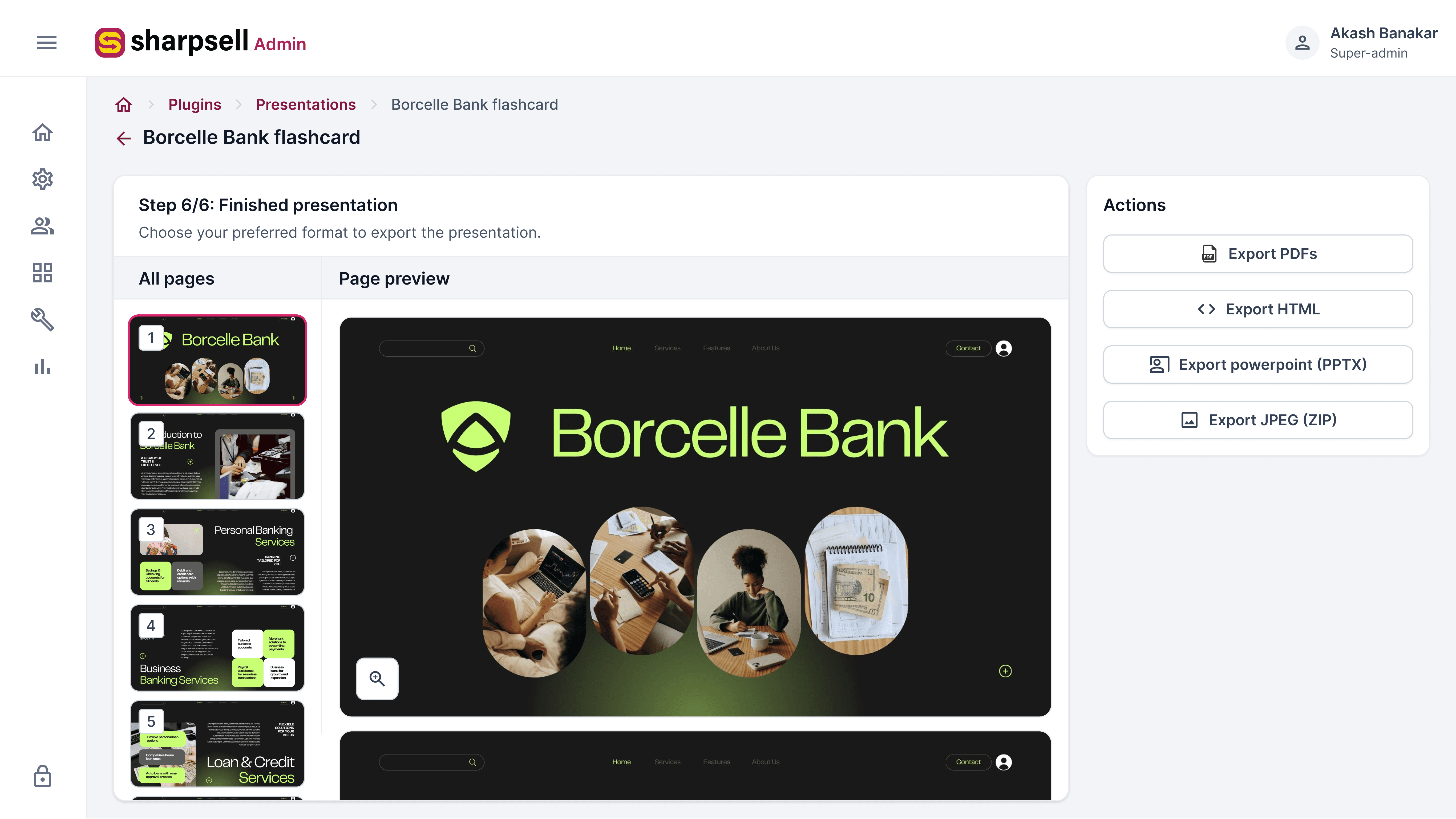

Craft is an AI powered presentation engine I designed for Sharpsell.ai, replacing a 13 person manual design service with a scalable, configuration driven content pipeline for 6+ industries, including banking and insurance.
Timeline
From explorations to final designs in 3 months while working with multiple small projects at the same time
Background
Every sales deck for banking and insurance clients was handcrafted by a 13 person internal design team. But demand had outgrown the model: 20 to 35 requests came in each month against a real capacity of 8 to 12, creating a 30 day backlog and 4 to 5 review cycles per deck. Deals were going cold before pitches even happened. This was not an operational issue; it was a structural bottleneck.
Craft was the architectural response: an AI Powered presentation engine that converted a manual design service into a scalable, configuration-driven content pipeline, where 80% of the work no longer required a designer to “draw.” I led the design end-to-end as the sole designer, partnering closely with the PM and co-founder.
This category details the step by step approach taken during the project, including research, planning, design, development, testing, and optimization phases.
Research & Planning
Ran structured research interviews with the in-house design team to map the existing service end-to-end, request volume, the brief intake process, review cycles, turnaround times.
Defining
Worked directly with the PM across entity modeling, workflow architecture. Hardened constraints over freedom, section level guidelines, deterministic property locks, explicit capacity attributes, so the AI couldn't hallucinate.
Design & Prototyping
Decomposed "a slide" into five programmable entities (Presentation Types, Content Structures, Templates, Layouts, Elements), Designed state machine workflow with explicit dual gates, technical validation plus human sign offs at every stage.
Testing & Optimization
Shipped the pipeline end to end, then hit expert review where output was "decent, not good enough." Spent two weeks immersed with the content team, extracting tacit heuristics into typed Presentation Type configs and feeding them back into the pipeline to close the quality gap.
The resulting AI presentation engine turned a manual design service into a configuration driven pipeline, letting Sharpsell scale enterprise grade decks without scaling the design team.
Entity Model
Decomposed "a slide" into five programmable objects: Presentation Types, Content Structures, Templates, Layouts, and Elements, making the design space navigable for both humans and the AI.
Six-Step Workflow
A state machine pipeline from Presentation Type selection through brief extraction, coverage analysis, sectioning, AI review, and copy generation, each step independently re-runnable and gated by explicit human sign off.
Knowledge Layer
Typed Presentation Type configs encode expert heuristics, section guidelines, content handling rules, deterministic property locks, so the AI operates within constraints set by domain experts.


The pipeline shipped end-to-end and the entity model held, but the first cut of generated output failed the expert bar, forcing a strategic pivot that reshaped how I thought about AI products.
The Quality Gap
Expert content writers reviewed the AI's output and called it "decent, but not good enough to ship." For banking and insurance clients, "decent" meant unusable, every end user was a domain expert who could spot a generic disclaimer.
Tacit Knowledge Was Missing
The system worked exactly as designed; the AI was making content decisions that required deep domain judgment we had never made explicit. Micro-decisions, which feature gets headline treatment, how to phrase a disclaimer that doesn't alarm, lived only in senior writers' heads.
We spent two weeks embedded with the content team, shadowing, writing decks ourselves, getting them torn apart, then structured every extracted heuristic into typed Presentation Type configs.